There are many financial and non-financial benefits to owning a home. Let’s connect to put your homeownership plans in motion this year.
North Idaho Real Estate Search
Real Estate News You Can Use
You’ll find our blog to be a wealth of information, covering everything from local market statistics and home values to community happenings. That’s because we care about the community and want to help you find your place in it. Please reach out if you have any questions at all. We’d love to talk with you!
July 1, 2020
New Index Reveals Impact of COVID-19 on Real Estate

Earlier this month, realtor.com announced the release of their initial Housing Recovery Index, a weekly guide showing how the pandemic has impacted the residential real estate market. The index leverages a weighted average of four key components of the housing industry, tracking each of the following:
- Housing Demand – Growth in online search activity
- Home Price – Growth in asking prices
- Housing Supply – Growth of new listings
- Pace of Sales – Difference in time-on-market
The index then compares the current status “to the last week of January 2020 market trend, as a baseline for pre-COVID market growth. The overall index is set to 100 in this baseline period. The higher a market’s index value, the higher its recovery and vice versa.”
The graph below charts the index by showing how the real estate market started out strong in early 2020, and then dropped dramatically at the beginning of March when the pandemic paused the economy. It also shows the strength of the recovery since the beginning of May.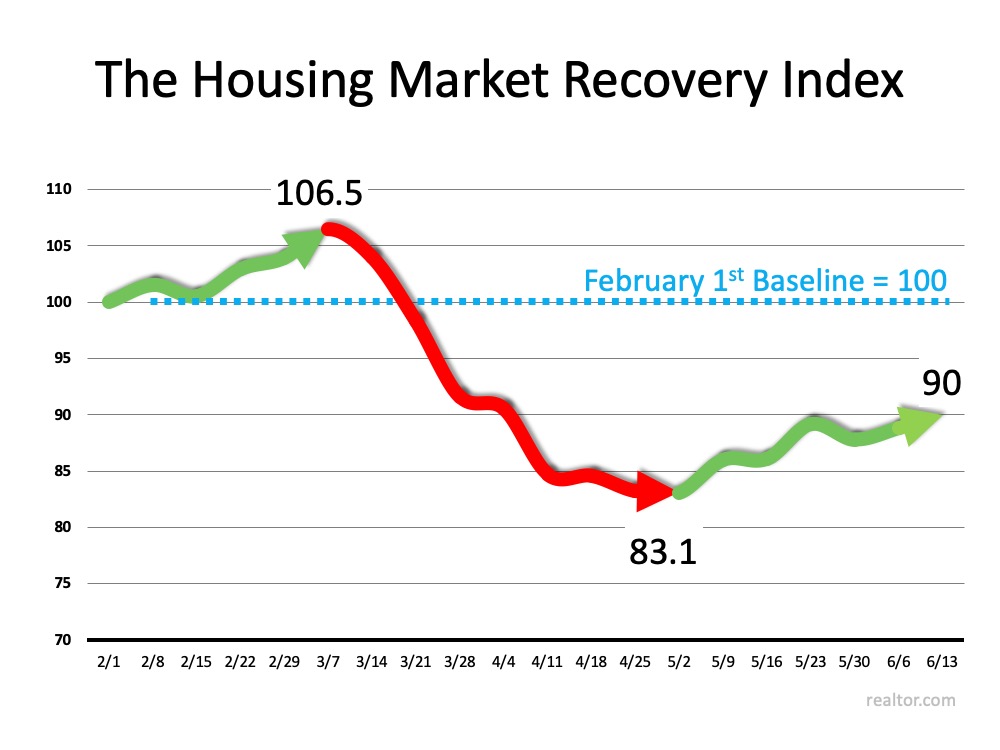 It’s clear to see that the housing market is showing promising signs of recovery from the deep economic cuts we experienced earlier this spring. As noted by Dean Mon, Chairman of the National Association of Home Builders (NAHB):
“As the nation reopens, housing is well-positioned to lead the economy forward.”
The data today indicates the housing market is already on the way up.
Bottom Line
Staying connected to the housing market’s performance over the coming months will be essential, as we continue to evaluate exactly how the housing market is doing in this uncharted time ahead.
July 1, 2020
Are New Homes Going to Be Available to Buy This Year?

In today’s economy, everyone seems to be searching for signs that a recovery is coming soon. Many experts agree that it may actually already be in motion or will be starting by the 3rd quarter of this year. With the housing market positioned to lead the way out of this recession, builder confidence might be a bright spark that gets the recovery fire started. The construction of new homes coming right around the corner is a huge part of that effort, and it may drive your opportunity to make a move this year.
According to the National Association of Home Builders (NAHB):
“New home sales jumped in May, as housing demand was supported by low interest rates, a renewed household focus on housing, and rising demand in lower-density markets. Census and HUD estimated new home sales in May at a 676,000 seasonally adjusted annual pace, a 17% gain over April.”
In addition, builder confidence is also rising, opening up opportunity for newly constructed homes in the market. The NAHB also notes:
“In a sign that housing stands poised to lead a post-pandemic economic recovery, builder confidence in the market for newly-built single-family homes jumped 21 points to 58 in June, according to the latest National Association of Home Builders/Wells Fargo Housing Market Index (HMI). Any reading above 50 indicates a positive market.”
As noted above, this upward trend is supported by builders reporting an increase in demand for single-family homes in suburban neighborhoods with lower-density populations, a result of the COVID-19 health crisis.
Moreover, the most recent Monthly New Residential Construction Report from the U.S. Census indicates that authorized building permits for new residential construction increased by 14.4% month-over-month from April to May, and housing starts were also up 4.3% over the same time period. (See graph below):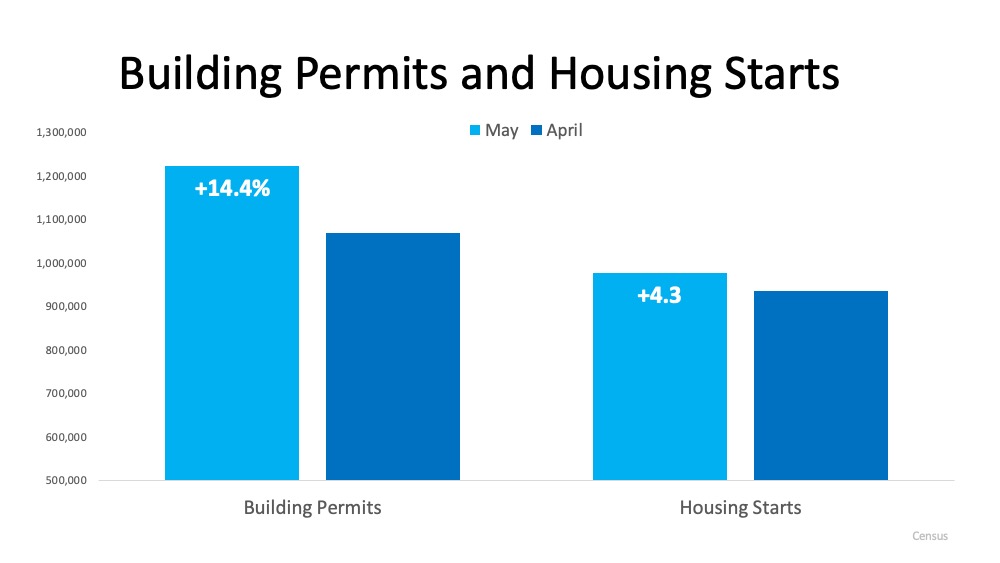 Although housing permits and starts are both considerably lower than they were at this time last year, indicating the new construction market is still working on building its way back up, the trends are moving in the right direction when it comes to having an impact on the U.S. economy. They’re also poised to create the much-needed new homes for Americans to purchase in a time when inventory is so scarce.
Dean Mon, Chairman of the NAHB notes:
“As the nation reopens, housing is well-positioned to lead the economy forward…Inventory is tight, mortgage applications are increasing, interest rates are low and confidence is rising. And buyer traffic more than doubled in one month even as builders report growing online and phone inquiries stemming from the outbreak.”
The gap between homes to buy and the high demand from purchasers may be narrowed by new construction, and the data shows that these homes are on their way into the housing market.
So, if you’ve debated whether or not to sell your house this year because you’re not sure where to move, a newly-built home – designed to your specific liking – may be your answer.
Bottom Line
With new residential construction right around the corner, you can feel confident about selling your house and having a place to move into. Maybe it’s time to finally design the home you’ve always wanted. Let’s connect today to discuss selling your house while demand from eager buyers is high.
Posted in
Buying
June 5, 2020
Three Things to Understand About Unemployment Statistics

Tomorrow morning the Bureau of Labor Statistics will release the latest Employment Situation Summary, which will include the most current unemployment rate. It will be a horrific number. Many analysts believe unemployment could be greater than 20%. These numbers represent families across the nation that are not sure when (or if) they will return to work. The emotional impact on these households is devastating.
There are, however, some small rays of light shining through on this issue. Here are three:
1. The actual number of unemployed is less than many are reporting
The number of people unemployed is sometimes over-exaggerated. It seems that every newscaster talks about the 40+ million people “currently” unemployed. It is true that, over the last ten weeks, over 40.7 million people have applied for unemployment. It is also true, however, that many of those people have already returned to work or gotten a new job. The actual number of people currently unemployed is 21.1 million. This is still a horrible number, but about half of what is often being reported.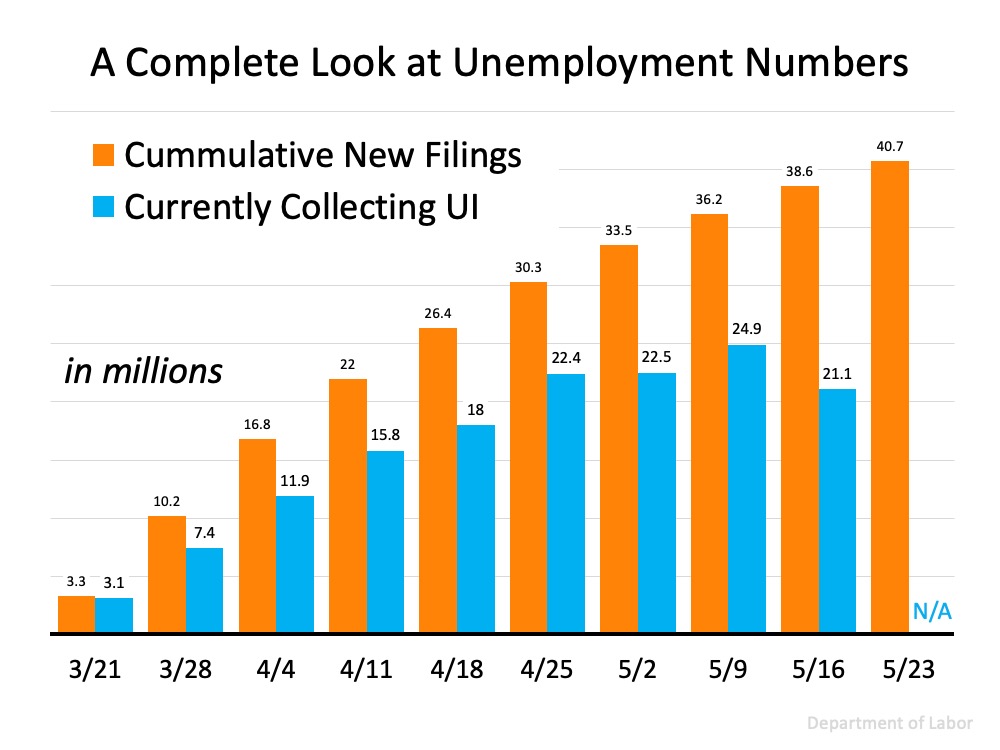
2. Of those still unemployed, most are temporary layoffs
Last month’s unemployment report showed that 90% of those unemployed believe their status is temporary. Friday’s report will probably show a decline in that percentage as the original number was somewhat optimistic. However, a recent survey by the Federal Reserve Bank showed that employers believe over 75% of job losses are temporary layoffs and furloughs. This means 3 out of 4 people should be returning to work as the economy continues to recover.
3. Those on unemployment are receiving assistance
According to a recent study from the Becker Friedman Institute for Economics at the University of Chicago, 68% of those who are eligible for unemployment insurance receive benefits that exceed lost earnings, with 20% receiving benefits at least twice as large as their lost earnings.
Bottom Line
Tomorrow’s report will be difficult to digest. However, as the nation continues to reopen, many of those families who are impacted will be able to return to work.
May 31, 2020
Why This Summer Is the 2020 Real Estate Season

With stay-at-home orders starting to gradually lift throughout parts of the country, data indicates homebuyers are jumping back into the market. After many families put their plans on hold due to the COVID-19 pandemic, what we once called the busy spring real estate season is shifting into the summer. In 2020, summer is the new spring for real estate.
Joel Kan, Economist at The Mortgage Bankers Association (MBA) notes:
“Applications for home purchases continue to recover from April’s sizable drop and have now increased for five consecutive weeks…Government purchase applications, which include FHA, VA, and USDA loans, are now 5 percent higher than a year ago, which is an encouraging turnaround after the weakness seen over the past two months.”
Additionally, according to Google Trends, which scores search terms online, searches for real estate increased from 68 points the week of March 15th to 92 points last week. As we can see, more potential homebuyers are looking for homes virtually.
What’s the Opportunity for Buyers?
Another reason buyers are coming back to the market, even with forced unemployment and stay-at-home orders, is historically low mortgage rates. Sam Khater, Chief Economist at Freddie Mac indicates:
“For the fourth consecutive week, the 30-year fixed-rate mortgage has been below 3.30 percent, giving potential buyers a good reason to continue shopping even amid the pandemic…As states reopen, we’re seeing purchase demand improve remarkably fast, now essentially flat relative to a year ago.”
With mortgage rates at such low levels and states gradually beginning to reopen, there’s more incentive than ever to buy a home this summer.
What’s the Opportunity for Sellers?
Finding a home to buy, however, is still a challenge, as this spring sellers removed many listings from the market. Though more people are now putting their houses up for sale this month as compared to last month, current inventory is still well below last year’s level.
According to last week’s Weekly Economic and Housing Market Update from realtor.com:
“Weekly Housing Inventory showed continued tightening. New Listings declined 28% compared with a year ago, as sellers grappled with uncertainty and hesitated bringing homes to market. Total Listings dropped 20% YoY, a faster rate than in prior weeks, leaving very few homes available for sale. As Time on Market was 15 days slower YoY, asking prices moved up 1.5% YoY.”
If you’re thinking of selling your house this summer, now may be your best opportunity. With so few homes on the market for buyers to purchase, this season may be the time for your house to stand out from the crowd. Trusted real estate professionals can help you list safely and effectively, keeping your family’s needs top of mind. Buyers are looking, and your house may be at the top of their list.
Bottom Line
If you’re thinking of selling, many buyers may be eager to find a home just like yours. Let’s connect today to make sure you can get your house in on the action this summer.
May 31, 2020
Why Virtual Tours Are Winning in 2020
Virtual tours are changing the game for the real estate market this year. Let’s connect to make sure you’re ready to navigate the digital side of the homebuying process in 2020.
Posted in
Selling
May 31, 2020
Economists Forecast Recovery to Begin in the Second Half of 2020

With the U.S. economy on everyone’s minds right now, questions about the country’s financial outlook continue to come up daily. The one that seems to keep rising to the top is: when will the economy begin to recover? While no one knows exactly how a rebound will play out, expert economists around the country are becoming more aligned on when the recovery will begin.
According to the latest Wall Street Journal Economic Forecasting Survey, which polls more than 60 economists on a monthly basis, 85.3% believe a recovery will begin in the second half of 2020 (see graph below):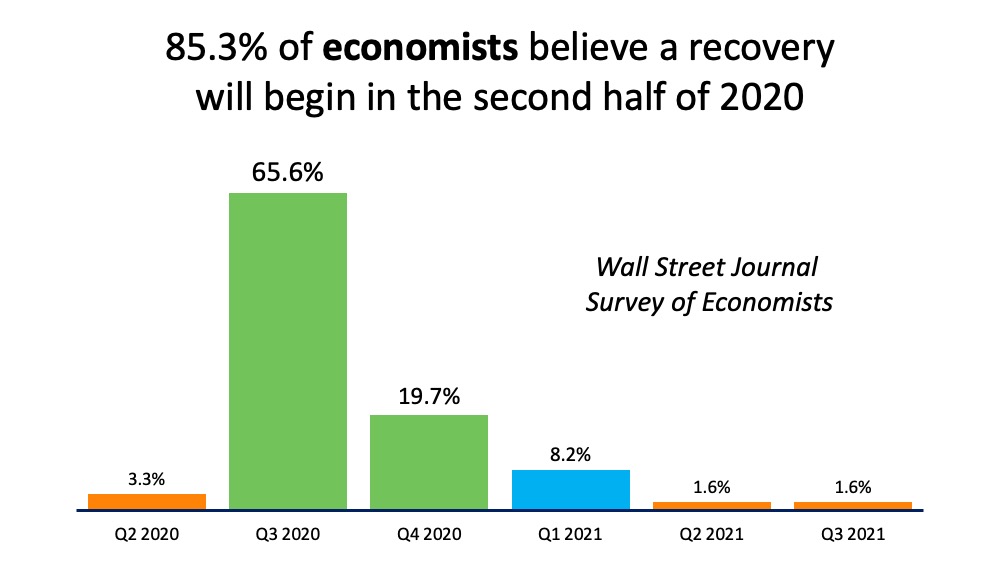 There seems to be a growing consensus among these experts that the second half of this year will be the start of a turnaround in this country.
Chris Hyzy, Chief Investment Officer for Merrill notes:
“We fully expect the economy could begin to pick up in late June and July with a strong recovery in the fourth quarter.”
In addition, five of the major financial institutions are also forecasting positive GDP in the second half of the year. Today, four of the five expect a recovery to begin in the third quarter of 2020, and all five agree a recovery should start by the fourth quarter (see graph below):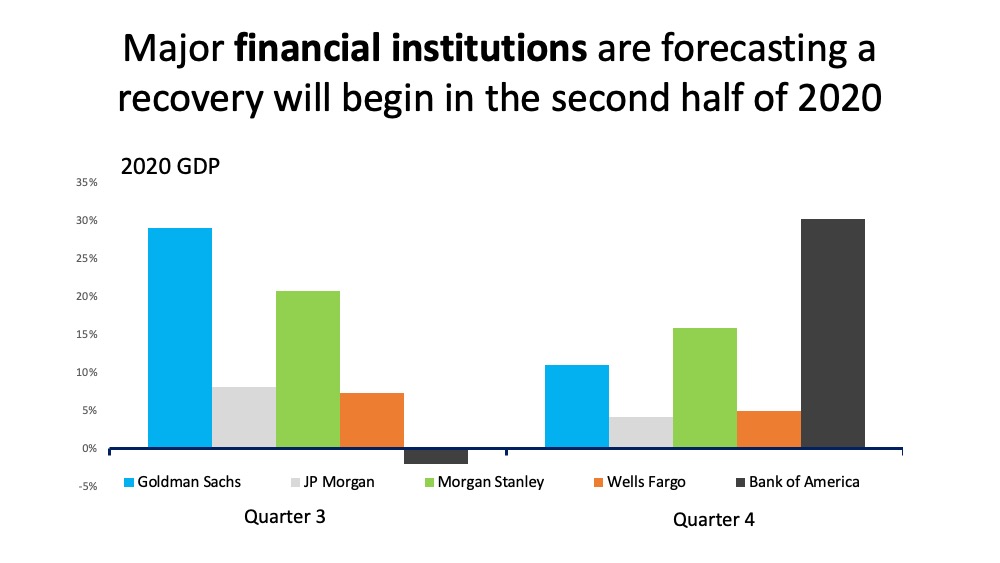
Bottom Line
The vast majority of economists, analysts, and financial institutions are in unison, indicating an economic recovery should begin in the second half of 2020. Agreement among these leading experts is stronger than ever.
May 31, 2020
Summer Is the New Spring Market
Summer is gearing up to be the new spring for homebuying and selling! Let's connect so you're ready to make your move this season.
May 31, 2020
Top Reasons to Own Your Home [INFOGRAPHIC]

![Top Reasons to Own Your Home [INFOGRAPHIC] | MyKCM](https://files.mykcm.com/2020/05/28130106/20200529-MEM-1046x1619.jpg)
Some Highlights
- June is National Homeownership Month, and it’s a great time to consider the benefits of owning your own home.
- If you’re in a position to buy, homeownership might help you find the stability, community, and comfort you’ve been searching for this year.
- Let’s connect today to determine if homeownership is the right next step for you and your family.
Posted in
Buying
May 31, 2020
What the Experts See Coming for the Housing Market
Experts are optimistic that the housing market will rebound as the country emerges from stay-at-home orders. Let's connect to discuss how these key insights may fuel your plans to buy or sell a home this year.