Real Estate News You Can Use

You’ll find our blog to be a wealth of information, covering everything from local market statistics and home values to community happenings. That’s because we care about the community and want to help you find your place in it. Please reach out if you have any questions at all. We’d love to talk with you!

Dec. 1, 2019

7 Reasons to List Your House This Holiday Season

Around this time each year, many homeowners decide to wait until after the holidays to list their houses. Similarly, others who already have their homes on the market remove their listings until the spring. Let’s unpack the top reasons why listing your house now or keeping it on the market this winter may be the best choice you can make.

Here are seven great reasons not to wait:

  1. Relocation buyers are out there now. Many companies are still hiring throughout the holidays, and they need their new employees to start as soon as possible.
  2. Purchasers who are looking for homes during the holidays are serious buyers and are ready to buy now.
  3. You can restrict the showings on your home to days and times that are most convenient for you. You will remain in control.
  4. Homes show better when decorated for the holidays.
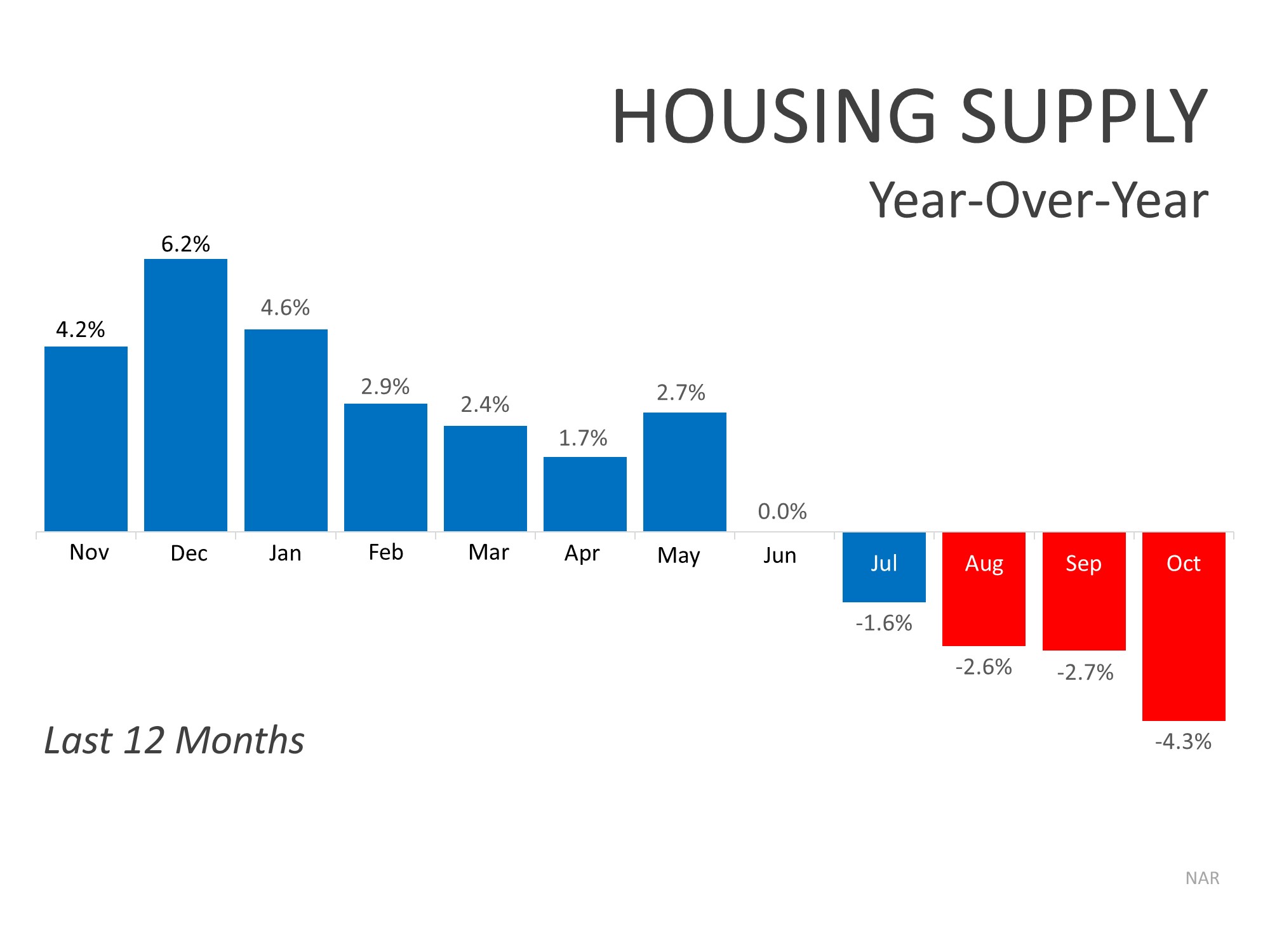
  5. There is minimal competition for you as a seller right now. Over the past few months we’ve seen the supply of homes for sale decreasing year-over-year, as shown in the graph below:7 Reasons to List Your House This Holiday Season | MyKCM
  6. The desire to own a home doesn’t stop during the holidays. Buyers who were unable to find their dream homes during the busy spring and summer months are still searching, and your home may be the answer.
  7. Late fall and early winter make up the “sweet spot” for sellers. The supply of listings increases substantially after the holidays. Also, in many parts of the country, new construction will continue to surge and reach new heights in 2020, which will lessen the demand for your house next year.

Bottom Line

It may make the most sense to list your home this holiday season. Let’s get together to determine if selling now is your best move.


 

Posted in Selling
Dec. 1, 2019

The True Cost of Not Owning Your Home

There are great advantages to owning a home, yet many people continue to rent. The financial benefits are just some of the reasons why homeownership has been a part of the long-standing American dream.

Realtor.com reported that:

“Buying remains the more attractive option in the long term – that remains the American dream, and it’s true in many markets where renting has become really the shortsighted option…as people get more savings in their pockets, buying becomes the better option.”

Why is owning a home financially better than renting?

Here are the top 5 financial benefits of homeownership:

  1. Homeownership is a form of forced savings.
  2. Homeownership provides tax savings.
  3. Homeownership allows you to lock in your monthly housing cost.
  4. Buying a home is less expensive than renting.
  5. No other investment lets you live inside of it.

Studies have also shown that a homeowner’s net worth is 44x greater than that of a renter.

A family that purchased a median-priced home at the start of 2019 would build more than
$37,750 in family wealth over the next five years with projected price appreciation alone.

Some argue that renting eliminates the cost of taxes and home repairs, but every potential renter must realize that all the expenses the landlord incurs are already baked into the rent payment – along with a profit margin!

Bottom Line

Owning a home has many social and financial benefits that cannot be achieved by renting. Let’s connect to determine if buying a home is your best move.

Posted in Buying
Dec. 1, 2019

Tips to Sell Your Home Faster

When selling your house, there are a few key things you can prioritize to have the greatest impact for a faster sale:

1. Make Buyers Feel at Home

Declutter your home! Pack away all personal items like pictures, awards, and sentimental belongings. Make buyers feel like they belong in the house. According to the 2019 Profile of Home Staging by the National Association of Realtors, “83% of buyers’ agents said staging a home made it easier for a buyer to visualize the property as a future home.”

Not only will your house spend less time on the market, but the same report mentioned that, “One-quarter of buyers’ agents said that staging a home increased the dollar value offered between 1 – 5%, compared to other similar homes on the market that were not staged.”

2. Keep It Organized

Since you took the time to declutter, keep it organized. Before buyers arrive, pick up toys, make the bed, and put away clean dishes. According to the same report, the kitchen is one of the most important rooms to stage in order to attract more buyers. Put out a scented candle or some cookies fresh from the oven. Buyers will remember the smell of your home.

3. Price It Right

More inventory coming into the market guarantees there will be some competition. You want to make sure your home is noticed. A key to selling your house is ensuring it is Priced to Sell Immediately (PTSI). This means you’ll be driving more traffic to your property, and ultimately creating more interest in your home.

4. Give Buyers Full Access

One of the top four elements when selling your home is access. If your home is available anytime, that opens up more opportunity to find a buyer right away. Some buyers, especially those relocating, don’t have much time available. If they cannot get into the house, they will move on to the next one.

Bottom Line

If you want to sell your home in the least amount of time at the best price with as little hassle as possible, a local real estate professional is a useful guide. Let’s connect today to determine what you need to do to sell your home as quickly as possible.

Posted in Selling
Dec. 1, 2019

Thank You For Making Me Your Trusted Advisor

Thank you for your support and your lifelong partnership on the real estate journey. Let's connect again, continuing to make your homeownership dreams come true.

Posted in Buying, Selling
Dec. 1, 2019

Buyers Are Looking For Your Home

Some Highlights:

  • Existing Home Sales are currently at an annual pace of 5.46 million.
  • The inventory of existing homes for sale remains below the 6 months needed for a normal market and is now at a 3.9-month supply.
  • Inventory remains low due to high demand from buyers who are still looking for a house to buy!
Posted in Selling
Nov. 14, 2019

75 Years of VA Home Loan Benefits

Today, on Veterans Day, we salute those who have served our country in war or peace, and we thank them for their sacrifice.

This year marks the 75th anniversary of VA Home Loan Benefit offerings through the Servicemen’s Readjustment Act, also known as the GI Bill. Since 1944, this law has created opportunities for those who have served our country, ranging from vocational training to home loans.

Facts About VA Home Loans:

  • Nearly 24 million home loans have been guaranteed by the Veterans Administration.
  • Nearly 82% of VA home loans are made with no down payment.
  • The VA also provides grants to help seriously disabled Veterans purchase, modify, or construct a home to meet their needs. Last year the VA provided 2,000 grants totaling $104 million.

Benefits of a VA Home Loan:

  1. No down payment
  2. No Private Mortgage Insurance*
  3. Lower credit score requirements
  4. Limitation on closing costs
  5. Lower average interest rates

*More information on VA Home Loan Fees

 Bottom Line

The best thing you can do today to celebrate Veterans Day is to share this information with those who can benefit from these opportunities. For more information, or to find out how to qualify to use a VA Home Loan Benefit, let’s get together to navigate through the process. Thank you for your service!


Posted in Buying
Nov. 14, 2019

Is it a Buyer's or Seller's Market?

With today's advantages for buyers and sellers at different ends of the market, you need an expert on your side to help you navigate the ever-changing waters. Let's connect and determine if you're ready to make your next move.

Posted in Buying, Selling
Nov. 14, 2019

Forget the Price of the Home. The Cost is What Matters.

Home buying activity (demand) is up, and the number of available listings (supply) is down. When demand outpaces supply, prices appreciate. That’s why firms are beginning to increase their projections for home price appreciation going forward. As an example, CoreLogic increased their 12-month projection for home values from 4.5% to 5.6% over the last few months.

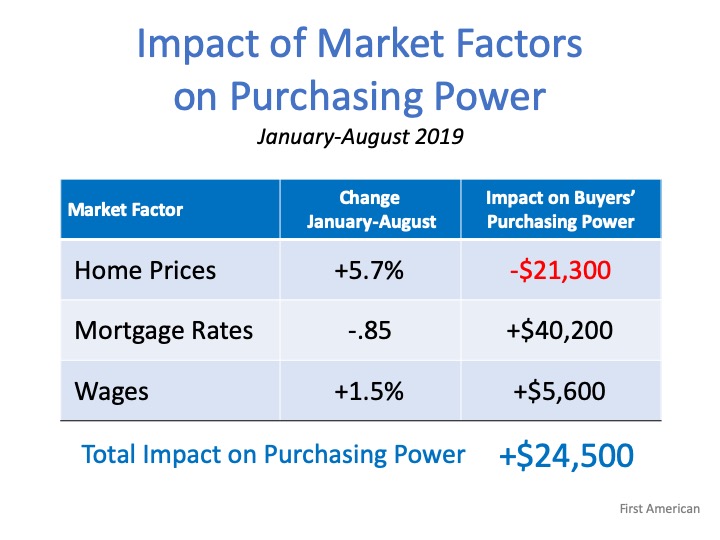
The reacceleration of home values will cause some to again voice concerns about affordability. Just last week, however, First American came out with a data analysis that explains how price is not the only market factor that impacts affordability. They studied prices, mortgage rates, and wages from January through August of this year. Here are their findings:

Home Prices

“In January 2019, a family with the median household income in the U.S. could afford to buy a $373,900 house. By August, that home had appreciated to $395,000, an increase of $21,100.”

Mortgage Interest Rates

“The 0.85 percentage point drop in mortgage rates from January 2019 through August 2019 increased affordability by 9.7%. That translates to a $40,200 improvement in house-buying power in just eight months.”

Wage Growth

“As rates have fallen in 2019, the economy has continued to perform well also, resulting in a tight labor market and wage growth. Wage growth pushes household incomes upward, which were 1.5% higher in August compared with January. The growth in household income increased consumer house-buying power by 1.5%, pushing house-buying power up an additional $5,600.”

When all three market factors are combined, purchasing power increased by $24,500, thus making home buying more affordable, not less affordable. Here is a table that simply shows the data:Forget the Price of the Home. The Cost is What Matters. |  MyKCM

Bottom Line

In the article, Mark Fleming, Chief Economist at First American, explained it best:

“Focusing on nominal house price changes alone as an indication of changing affordability, or even the relationship between nominal house price growth and income growth, overlooks what matters more to potential buyers – surging house-buying power driven by the dynamic duo of mortgage rates and income growth. And, we all know from experience, you buy what you can afford to pay per month.”

Posted in Buying
Nov. 14, 2019

3 Keys to Selling Your House Quickly

Ready to sell your house? Let's connect to make sure it sells quickly. Here are three tips to get you started.

Posted in Selling
Nov. 14, 2019

This is Not 2008 All Over Again: The Mortgage Lending Factor

Some are afraid the real estate market may be looking a lot like it did prior to the housing crash in 2008. One of the factors they’re pointing at is the availability of mortgage money. Recent articles about the availability of low-down payment loans and down payment assistance programs are causing concern that we’re returning to the bad habits of a decade ago. Let’s alleviate the fears about the current mortgage market.

The Mortgage Bankers’ Association releases an index several times a year titled: The Mortgage Credit Availability Index (MCAI). According to their website:

“The MCAI provides the only standardized quantitative index that is solely focused on mortgage credit. The MCAI is…a summary measure which indicates the availability of mortgage credit at a point in time.”

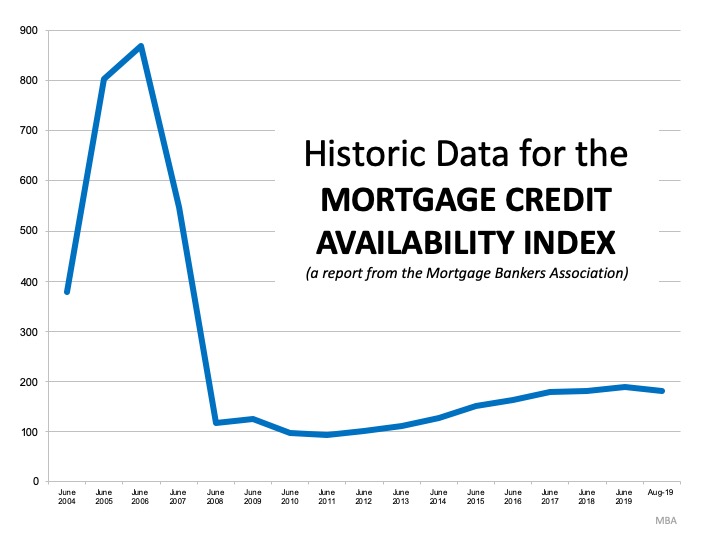
Basically, the index determines how easy it is to get a mortgage. The higher the index, the more available the mortgage credit.

Here is a graph of the MCAI dating back to 2004, when the data first became available:This is Not 2008 All Over Again: The Mortgage Lending Factor | MyKCM  As we can see, the index stood at about 400 in 2004. Mortgage credit became more available as the housing market heated up, and then the index passed 850 in 2006. When the real estate market crashed, so did the MCAI (to below 100), as mortgage money became almost impossible to secure.

Thankfully, lending standards have eased since. The index, however, is still below 200, which is half of what it was before things got out of control.

Bottom Line

It is easier to get a mortgage today than it was immediately after the market crash, but it is still difficult. The difference in 2006? At that time, it was difficult not to get a mortgage.

Posted in Buying, Selling