The latest reports indicate that homeownership is still cheaper than renting in the United States. Let's get together to find you your dream home - it may be cheaper than you think!
You’ll find our blog to be a wealth of information, covering everything from local market statistics and home values to community happenings. That’s because we care about the community and want to help you find your place in it. Please reach out if you have any questions at all. We’d love to talk with you!
The latest reports indicate that homeownership is still cheaper than renting in the United States. Let's get together to find you your dream home - it may be cheaper than you think!

Last week, the National Association for Business Economics released their February 2019 Economic Policy Survey. The survey revealed that a majority of the panel believe an economic slowdown is in the near future:
“While only 10% of panelists expect a recession in 2019, 42% say a recession will happen in 2020, and 25% expect one in 2021.”
Their findings coincide with three previous surveys calling for a slowdown sometime in the next two years:
That raises the question: Will the real estate market be impacted like it was during the last recession?
A recession does not equal a housing crisis. According to the dictionary definition, a recession is:
“A period of temporary economic decline during which trade and industrial activity are reduced, generally identified by a fall in GDP in two successive quarters.”
During the last recession, prices fell dramatically because the housing collapse caused the recession. However, if we look at the previous four recessions, we can see that home values weren’t negatively impacted:
Most experts agree with Ralph McLaughlin, CoreLogic’s Deputy Chief Economist, who recently explained:
“There’s no reason to panic right now, even if we may be headed for a recession. We’re seeing a cooling of the housing market, but nothing that indicates a crash.”
The housing market is just “normalizing”. Inventory is starting to increase and home prices are finally stabilizing. This is a good thing for both buyers and sellers as we move forward.
If there is an economic slowdown in our near future, there is no need for fear to set in. As renowned financial analyst, Morgan Housel, recently tweeted:
“An interesting thing is the widespread assumption that the next recession will be as bad as 2008. Natural to think that way, but, statistically, highly unlikely. Could be over before you realized it began.”
![Home Prices Up 5.73% Across the Country! [INFOGRAPHIC] | MyKCM](https://files.mykcm.com/2019/03/28120339/FHFA-ENG-MEM-1046x1600.jpg)

Just like our clocks this weekend, in the majority of the country, the housing market will soon “spring forward!” Similar to tension in a spring, the lack of inventory available for sale has been holding back the market.
Many potential sellers believe that waiting until Spring is in their best interest. Traditionally, they would have been right.
Buyer demand has seasonality to it. Usually, this falls off in the winter months, especially in areas of the country impacted by arctic conditions.
Demand for housing has remained strong as mortgage rates have remained near historic lows. Even with an increase in rates forecasted for 2019, buyers are still able to lock in an affordable monthly payment. Buyers are increasingly jumping off the fence and into the market to secure a lower rate.
The National Association of Realtors (NAR) recently reported that in 2018 the top 10 dates sellers listed their homes all fell in April, May, or June.
Those who act quickly and list now, before a flood of increased competition, will benefit from additional exposure to buyers.
If you are planning on selling your home in 2019, meet with a local real estate professional to evaluate the opportunities in your market.

Heading into the spring buying market, there are strong trends starting to emerge.
The inventory of homes for sale has increased on a year-over-year basis for eight months in a row. Home price appreciation has continued to grow, although at a slower rate. The homeownership rate has reached heights last seen in 2014, with millennials and Generation X leading the way!
Let’s dive a little deeper into some of the recent reports that have been released and what they mean for the spring buying season!
1. National Association of Realtor’s Existing Home Sales Report
Sales of existing homes were down for the third consecutive month in January. Some of this can be explained by the natural seasonality that the real estate market experiences every year, and some can be explained even further by a lack of homes available for sale on the market.
For the last eight months, the inventory of homes for sale has been higher when compared to the same month the year before. The challenge in the market is the mismatch of the type of home that is available for sale. First-time homebuyers looking for a starter home are often competing with other buyers to stand out, often outbidding each other.
Lawrence Yun, NAR’s Chief Economist, agrees that the market is still experiencing an inventory shortage.
“In particular, the lower end of the market is experiencing a greater shortage, and more home construction is needed.”
The median home price for homes sold in January was $247,500. This is up 2.8% from January 2018 and marks the 83rd consecutive month of year-over-year gains. The 2.8% growth in home prices represents the smallest year-over-year change since February 2012 but is a welcome change for buyers who had feared being priced out of the market.
Properties that sold in January were on the market for an average of 49 days with 38% of homes on the market for less than a month.
Yun is positive about how today’s market conditions will help buyers this spring,
“Existing home sales in January were weak compared to historical norms; however, they are likely to have reached a cyclical low. Moderating home prices combined with gains in household income will boost housing affordability, bringing more buyers to the market in the coming months.”
2. NAR’s Pending Home Sales Report
The national Pending Home Sales Index (PHSI) rose 4.6% to 103.2 in January from 98.7 in December. An index score of 100 is considered normal. All four major regions of the country experienced gains in January, with the largest increase coming in the South.
“The PHSI is a leading indicator for the housing sector, based on pending sales of existing homes. A sale is listed as pending when the contract has been signed but the transaction has not closed, though the sale usually is finalized within one or two months of signing.”
Increases in the PHSI often predict increases in the level of home sales in the coming months, which is great news for the housing market leading in to spring! Yun had this to say,
“Homebuyers are now returning and taking advantage of lower interest rates, while a boost in inventory is also providing more choices for consumers.”
The housing market in 2019 will require homeowners to list their house at the right price to attract buyers. If interest rates continue to stay low while wages increase, and more inventory comes to market, 2019 could be one of the best years for home sales in recent history.

Every family has a list of important dates. We celebrate birthdays, anniversaries, pet adoptions…and the list goes on. For 64.4 percent of households in the United States, this list includes the day they became a homeowner for the first time!
Why is this date important? Homeownership is not just a roof over your head! It represents shelter, stability, wealth, and pride! For decades, homeownership has been an important part of the American Dream!
However, many question if the next generations see the same benefits of homeownership as their predecessors.
1) Educational Achievement: Homeownership has a positive impact on academic achievement, including reading and math performance in children 3-12 years old.
2) Civic Participation: “Owning a home means owning a part of the neighborhood.” Homeowners have a stronger connection to their neighborhood and are more committed to volunteer.
3) Health Benefits: Adjusting for a range of demographic, socioeconomic and housing-related characteristics, homeowners have a substantial health advantage over renters.
4) Public Assistance: The report shows 47% of homeowners use their home equity credit lines to help pay other debts, diminishing their need for public assistance.
5) Property Maintenance and Improvement: A well-maintained home not only generates benefits through consumption and safety, but a high-quality structure also raises mental health.
6) Pride of Ownership: This place is uniquely “yours.” You can customize it according to your likes and personality.
In addition to financial benefits, homeownership also brings significant social benefits. These not only pertain to the family, but extend to the communities, the state, and the country!
Buying a home is an investment in your future!
Homeownership is and will always be part of the American Dream! There are many financial and non-financial benefits to take advantage of when owning a home. If owning a home is part of your dream, contact a local real estate professional to help you with the process!

The housing market has been hot for a while now. Homes have been flying off the shelves as fast as they have been listed. Buyers have been competing in bidding wars just to find a home to buy, let alone find their dream home.
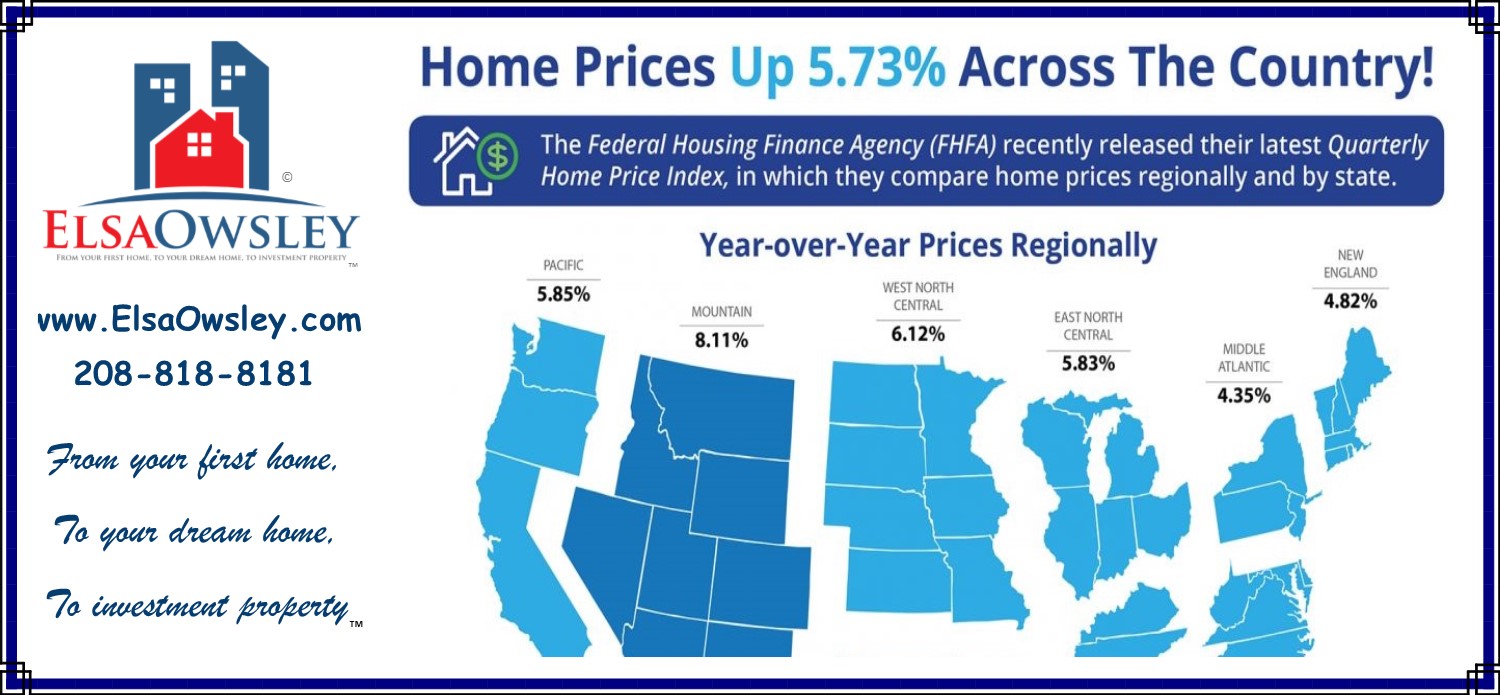
This ‘seller’s market’ has driven home prices to new heights. Home price appreciation averaged over 6% across the country.
However, home price growth has recently started to cool down. The latest report from CoreLogic shows that home prices have only risen by 4.7% over the last 12 months.
Many buyers and sellers planning to enter the housing market this year have started to wonder if we are headed towards another housing crash. Ralph McLaughlin, Deputy Chief Economist at CoreLogic, recently stated in an interview,
“There’s no reason to panic right now, even if we may be headed for a recession. We’re seeing a cooling of the housing market, but nothing that indicates a crash.
The real elephant in the room here is housing supply.”
The simple answer is we are returning to a ‘normal’ market. The inventory of homes for sale more closely matches the demand in the market. The added supply means fewer buyers are outbidding each other. Therefore, prices are experiencing less upward pressure. McLaughlin went on to explain,
“If there are a lot of homes on the market and suddenly no one wants to buy them, you’ll get into a downward spiral of price competition. Right now, however, we’re in the opposite situation, there isn’t an over-abundance of homes on the market.”
As more renters looking for their piece of the American Dream enter the housing market, demand for housing will continue to grow. The Joint Center for Housing Studies at Harvard University estimates over 30 million new households will enter the market from now through 2040.
“There’s the natural life cycle of young people getting older and starting to do adult life things which include … buying a house and that’s a lot of potential inertia that could last indefinitely.”
Home prices will start to appreciate by historical norms as we continue to head towards a more ‘normal’ market, rather than the over 6% seen over the course of the last couple of years. This is great news! Homeowners looking to sell their home will have buyers, as more buyers will be able to afford them!
If you want to sell your home soon, it's worth putting in the work now. Let's get together to chat and start the process!

With home prices softening, some are concerned that we may be headed toward the next housing crash. However, it is important to remember that today’s market is quite different than the bubble market of twelve years ago.
A decade ago, home prices depreciated dramatically, losing about 29% of their value over a four-year period (2008-2011). Today, prices are not depreciating. The level of appreciation is just decelerating.
Home values are no longer appreciating annually at a rate of 6-7%. However, they have still increased by more than 4% over the last year. Of the 100 experts reached for the latest Home Price Expectation Survey, 94 said home values would continue to appreciate through 2019. It will just occur at a lower rate.
Many are concerned that lending institutions are again easing standards to a level that helped create the last housing bubble. However, there is proof that today’s standards are nowhere near as lenient as they were leading up to the crash.
The Urban Institute’s Housing Finance Policy Center issues a quarterly index which,
“…measures the percentage of home purchase loans that are likely to default—that is, go unpaid for more than 90 days past their due date. A lower HCAI indicates that lenders are unwilling to tolerate defaults and are imposing tighter lending standards, making it harder to get a loan. A higher HCAI indicates that lenders are willing to tolerate defaults and are taking more risks, making it easier to get a loan.”
Last month, their January Housing Credit Availability Index revealed:
“Significant space remains to safely expand the credit box. If the current default risk was doubled across all channels, risk would still be well within the pre-crisis standard of 12.5 percent from 2001 to 2003 for the whole mortgage market.”
Within the last decade, distressed properties (foreclosures and short sales) made up 35% of all home sales. The Mortgage Bankers’ Association revealed just last week that:
“The percentage of loans in the foreclosure process at the end of the fourth quarter was 0.95 percent…This was the lowest foreclosure inventory rate since the first quarter of 1996.”
After using these three key housing metrics to compare today’s market to that of the last decade, we can see that the two markets are nothing alike.

Every three years, the Federal Reserve conducts their Survey of Consumer Finances. Data is collected across all economic and social groups. The latest survey data covers 2013-2016.
The study revealed that the median net worth of a homeowner is $231,400 – a 15% increase since 2013. At the same time, the median net worth of renters decreased by 5% ($5,200 today compared to $5,500 in 2013).
These numbers reveal that the net worth of a homeowner is over 44 times greater than that of a renter.
As we’ve said before, simply put, homeownership is a form of ‘forced savings.’ Every time you pay your mortgage, you are contributing to your net worth by increasing the equity in your home.
That is why Gallup reported that Americans picked real estate as the best long-term investment for the fifth year in a row. According to this year’s results, 34% of Americans chose real estate. Stocks followed at 26%, and then gold, savings accounts/CDs, or bonds.
If you want to find out how you can use your monthly housing cost to increase your family’s wealth, let’s get together to guide you through the process.