Homeownership has a number of compelling benefits. Let’s get together to make your dream a reality if you are ready to buy a home of your own!
You’ll find our blog to be a wealth of information, covering everything from local market statistics and home values to community happenings. That’s because we care about the community and want to help you find your place in it. Please reach out if you have any questions at all. We’d love to talk with you!
Homeownership has a number of compelling benefits. Let’s get together to make your dream a reality if you are ready to buy a home of your own!

As loved ones start to get older, we start to wonder: how long will they be able to live alone? Will they need someone there to help them with daily life? There’s a reason to ask those questions now more than ever, as the average life expectancy in the U.S. is 78 years old! As a result, 41% of Americans in the market are searching for a home that can accommodate a multigenerational family.
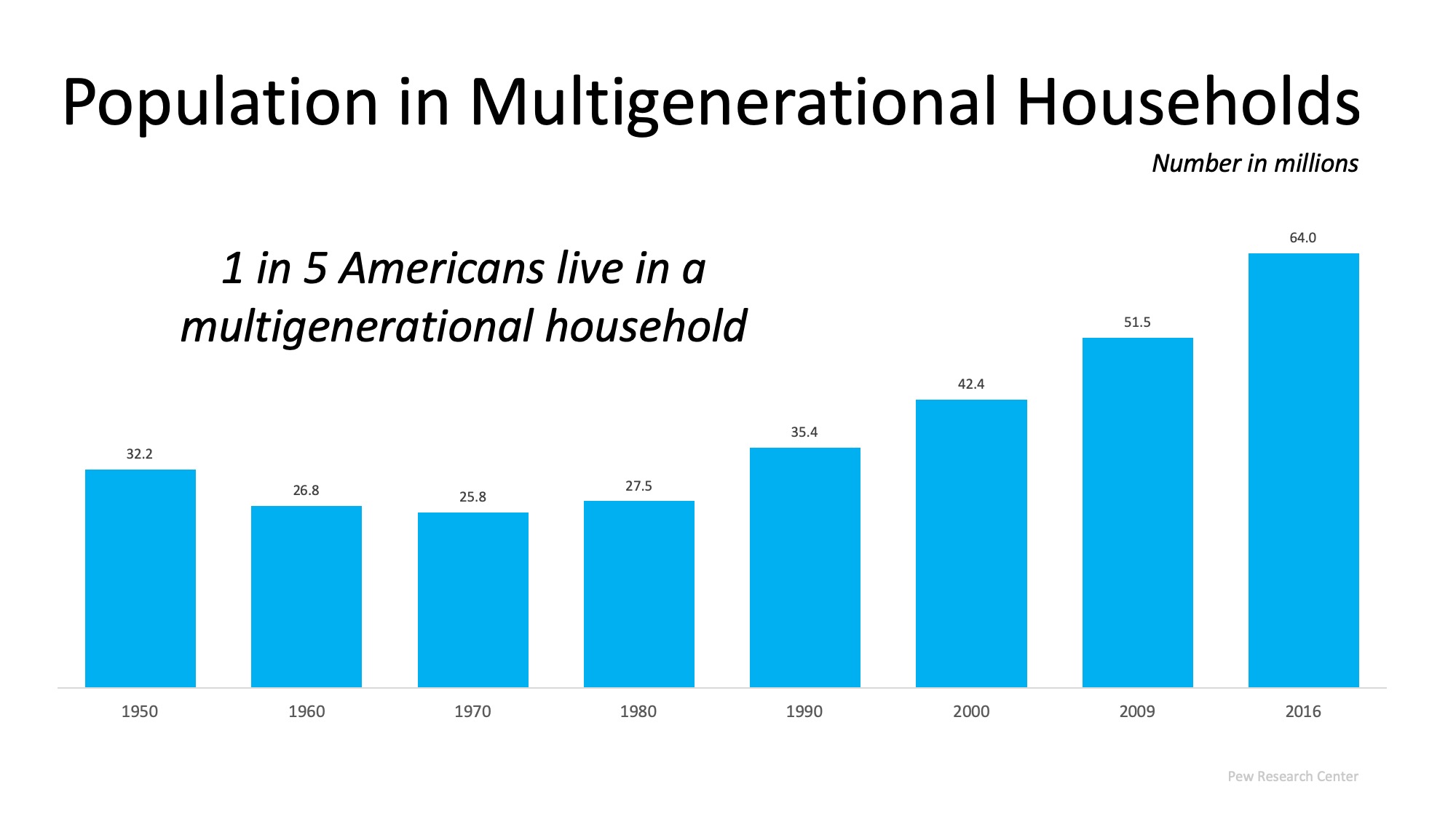
The graph below shows the number of people by generation that purchased a multigenerational home because they will either be taking care of an aging parent or they just want to spend time together.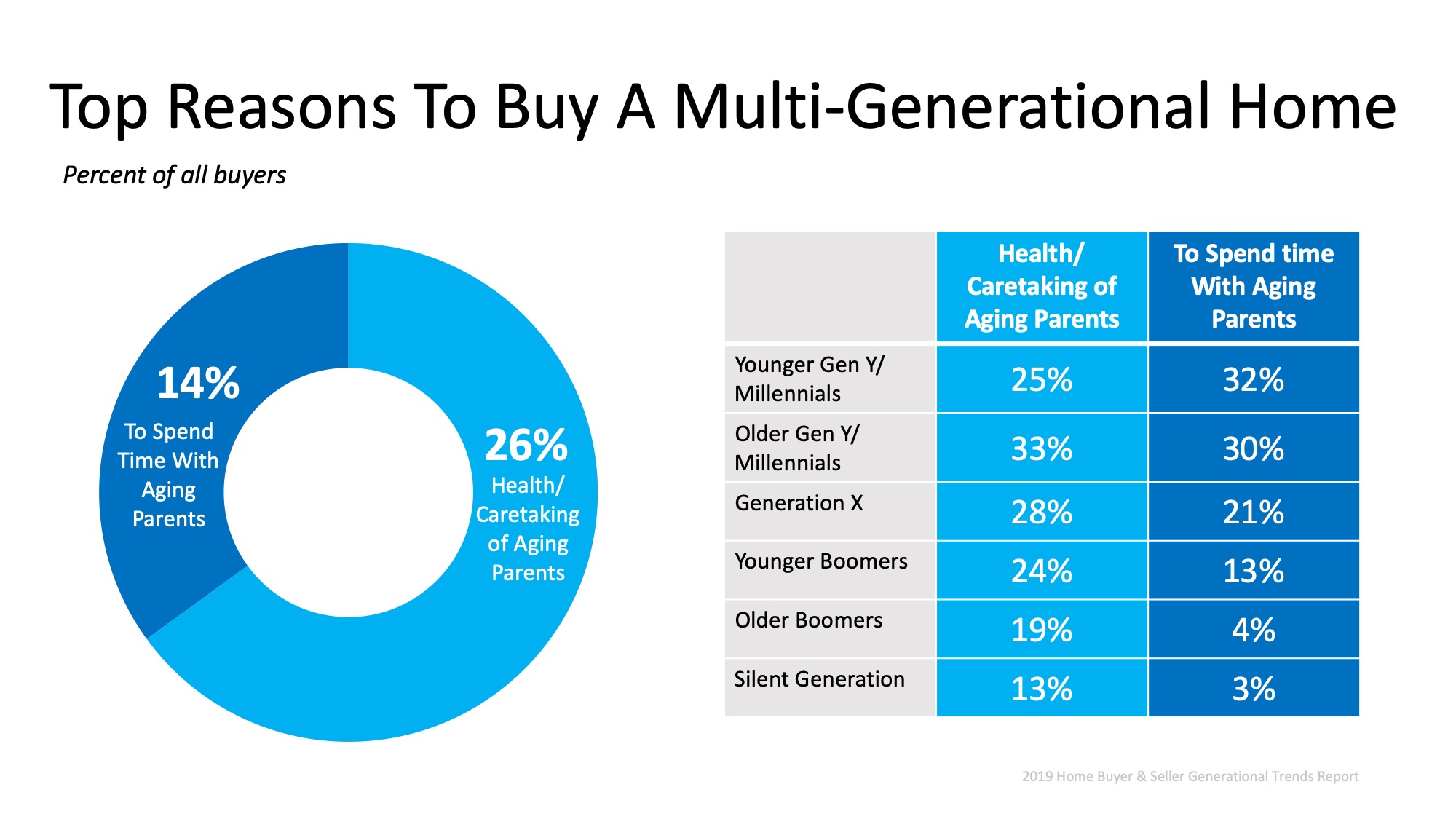 Of those buyers, 26% indicated they will be taking care of an aging parent, and 14% said they want to spend time with an aging parent. These numbers do not come as a surprise. According to Pew Research Center, 64 million Americans (20% of the population) lived in a multigenerational household in 2016 (Last numbers available).
 An increasing number of studies affirm the benefits of being part of a multigenerational household. These benefits aren’t just for the grandchildren, but for the grandparents as well. According to these two resources:
“Children who are close to their grandparents have fewer emotional and behavioral problems and are better able to cope with traumatic life events, like a divorce or bullying at school”.
“Researchers found that emotionally close ties between grandparents and adult grandchildren reduced depressive symptoms in both groups”.
This research gives helpful insight into why 41% of Americans are in the market to buy a multigenerational home.
If you have a home that could accommodate a multigenerational family and are thinking about selling, now is the perfect time to put it on the market! The number of buyers looking for this type of home will only continue to increase.

There have been many headlines decrying an “affordability crisis” in the residential real estate market. While it is true that buying a home is less affordable than it had been over the last ten years, we need to understand why and what that means.
On a monthly basis, the National Association of Realtors (NAR), produces a Housing Affordability Index. According to NAR, the index…
“…measures whether or not a typical family earns enough income to qualify for a mortgage loan on a typical home at the national and regional levels based on the most recent price and income data.”
Their methodology states:
“To interpret the indices, a value of 100 means that a family with the median income has exactly enough income to qualify for a mortgage on a median-priced home. An index above 100 signifies that family earning the median income has more than enough income to qualify for a mortgage loan on a median-priced home, assuming a 20 percent down payment.”
So, the higher the index, the more affordable it is to purchase a home. Here is a graph of the index going back to 1990:
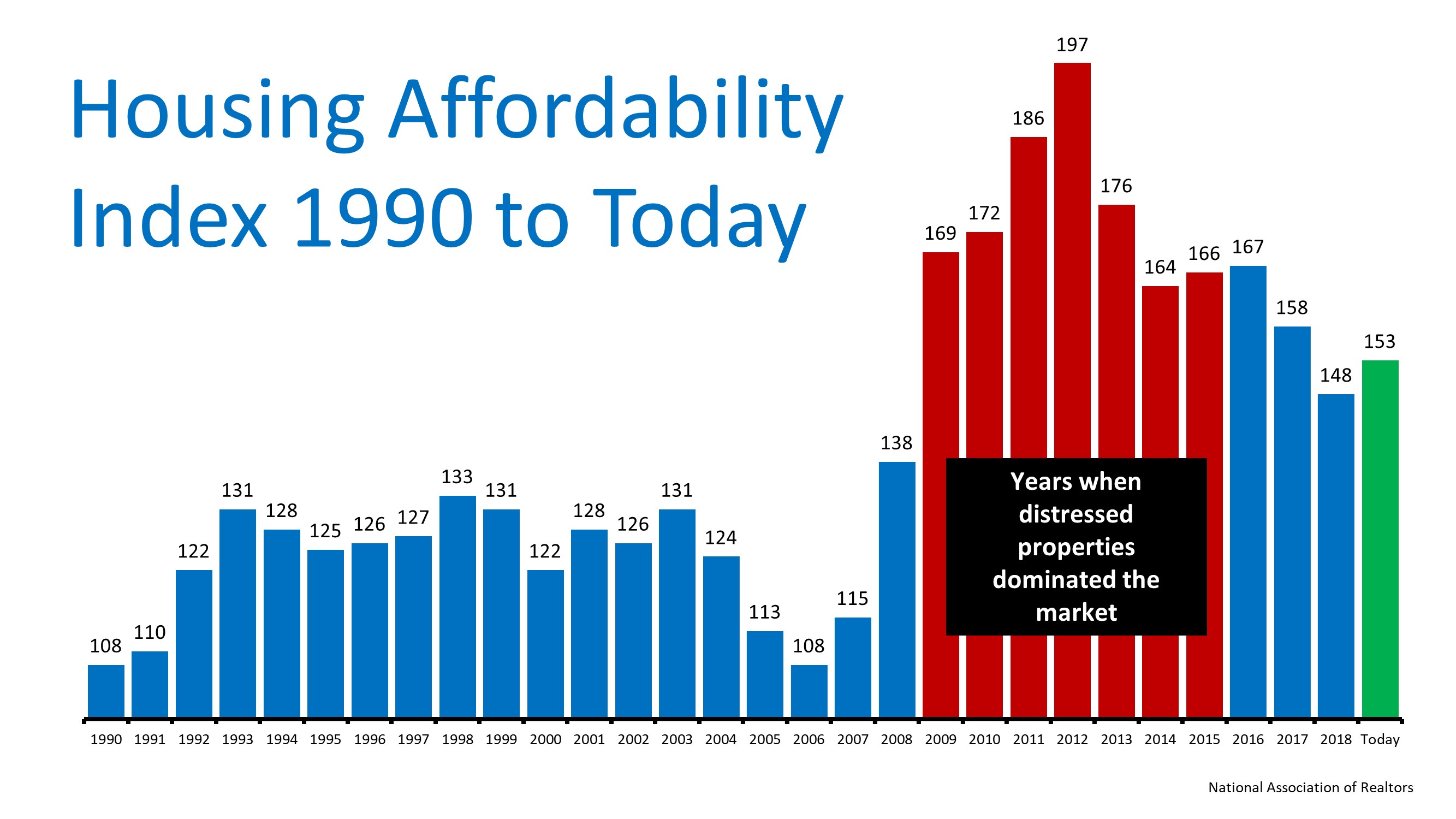
It is true that the index is lower today than any year from 2009 to 2017. However, we must realize the main reason homes were more affordable. That period of time immediately followed a housing crash and there were large numbers of distressed properties (foreclosures and short sales). Those properties were sold at large discounts.
Today, the index is higher than any year from 1990 to 2008. Based on historic home affordability data, that means homes are more affordable right now than any other time besides the time following the housing crisis.
With mortgage rates remaining low and wages finally increasing, we can see that it is MORE AFFORDABLE to purchase a home today than it was last year!
With wages increasing, price appreciation moderating, and mortgage rates remaining near all-time lows, purchasing a home is a great move based on historic affordability numbers.

Home prices have been on the rise for the last seven years, leading many housing market analysts to conclude that first-time homebuyers are being shut out of the market due to affordability concerns.
The National Association of Realtors (NAR) reports on the percentage of First-Time Home Buyers (FTHB) on a monthly and yearly basis. Their latest report shows that FTHB’s made up 33% of buyers in March, which matches their reported share in 2018.
NAR uses survey data from their members to come up with this statistic, so their results do not include every transaction completed. Rather, they only show the transactions reported by members who complete the survey.
The other entity that reports on FTHB share is the American Enterprise Institute (AEI). The AEI uses data from mortgage applications that define an FTHB as “any borrower who did not have a mortgage for the preceding three years.”
This means the AEI measurement also includes former homeowners who transitioned out of a home they previously owned and re-entered the market after at least 3 years. The latest FTHB share data from AEI shows that first-time buyers made up 57.5% of all mortgages in August 2018. NAR’s data shows a 31% share for the same time period.
New research from the New York Federal Reserve shows that these traditional reports on FTHB share have been unable to give an accurate depiction of this group’s involvement in the market.
The NY Fed was able to take consumer credit data and identify when a mortgage payment entered a consumer’s credit report to determine when a first-time home purchase was made. Using this data, they were able to show that AEI’s reported FTHB share was consistently 10% higher. The NAR reports were right on par with their findings until 2010, when NAR’s share dropped to the 11% gap seen today.
First-time home buyers have not disappeared from the market as many analysts had believed. Buying a home is very much a part of the American Dream for younger generations, just like it had been for their parents and grandparents.
This also means that rising prices have not scared buyers away from the market. Many first-time buyers are making sacrifices to save their down payment and make their dream a reality.
If you are one of the many renters who is scrolling through listings on your phone every night dreaming of buying your own home, there are opportunities in every market to make that dream a reality!
Before making any big purchases, moving money around, or making any big-time life changes, consult your loan officer. They will be able to tell you how your decision could impact your home loan.

![A Tale of Two Markets [INFOGRAPHIC] | MyKCM](https://files.mykcm.com/2019/05/29110946/20190510-ENG-STM-1046x1354.jpg)

If you are in the market to buy a home this year, you may be confused about how much money you need to come up with for your down payment. Many people you talk to will tell you that you need to save 20% or you won’t be able to secure a mortgage.
The truth is that there are many programs available that let you put down as little as 3%. Those who have served our country could qualify for a Veterans Affairs Home Loan (VA) without needing a down payment.
These programs have cut the savings time that many families would need to compile a large down payment from five or more years down to a year or two. This allows them to start building family wealth sooner.
So then, why do so many people believe that they need a 20% down payment to buy a home? There has to be a reason! Today, we want to talk about four reasons why putting 20% down is a good plan, if you can afford it.
Putting down a 20% down payment vs. a 3-5% down payment shows your lender/bank that you are more financially stable, thus a good credit risk. The more confident your bank is in your credit score and your ability to pay your loan, the lower the rate they will be willing to give you.
The bigger your down payment, the lower your loan amount will be for your mortgage. If you are able to pay 20% of the cost of your new home at the start of the transaction, you will only pay interest on the remaining 80%. If you put down a 5% down payment, the extra 15% on your loan will accrue interest and end up costing you more in the long run!
In a market where many buyers are competing for the same home, sellers like to see offers come in with 20% or larger down payments. The seller gains the same confidence that the bank did above. You are seen as a stronger buyer whose financing is more likely to be approved. Therefore, the deal will be more likely to go through!
Simply put, PMI is “an insurance policy that protects the lender if you are unable to pay your mortgage. It’s a monthly fee, rolled into your mortgage payment, that is required for all conforming, conventional loans that have down payments less than 20%.”
As we mentioned earlier, when you put down less than 20% to buy a home, your lender/bank will see your loan as having more risk. PMI helps them recover their investment in you if you are unable to pay your loan. This insurance is not required if you are able to put down 20% or more.
Many times, home sellers looking to move up to a larger or more expensive home are able to take the equity they earn from the sale of their house to put down 20% on their next home.
If you are looking to buy your first home, you will have to weigh the benefits of saving a 20% down payment vs. the time and cost of continuing to rent while you save that amount.
If your plan for your future includes buying a home and you’re already saving for your down payment, let’s get together to help you decide what down payment size best fits with your long-term plan!
In the next couple of months, millions of students will be graduating and moving out of their parents home. If you're a soon-to-be empty nester considering downsizing or making a move, let's get together to discuss your options!

Recently, we reported that many believe a recession could happen within the next two years. We explained that 70% of economists and market analysts surveyed last year believe that a recession will occur in 2019 or 2020 and that 42% of consumers currently looking to purchase a home also agree that a recession will occur this year or next.
However, the U.S. economy has performed well in the first quarter of 2019 and that has caused some experts to change their thinking on an impending economic slowdown.
“I feel really comfortable that the economy is slowing down this year, but not going into a recession… It doesn’t look, to me, like the odds of a recession in 2020 are there.”
“To sum up the general picture, the U.S. economy is definitely weakening… However, with wages growing at a respectable pace, and job growth remaining healthy, we should see enough consumption demand to keep the economy moving forward. That means slower growth, but no recession.”
“I’m not convinced a recession is coming soon… I see an improving housing market (low rates help), a rebound in bank lending, a tight labor market, higher oil prices and well-behaved credit markets. All these point to a stable U.S. economic outlook.”
We are seeing a stronger economy than many had predicted. That has caused some experts to push off the possibility of a recession further into the horizon.

The housing crisis is finally in the rear-view mirror as the real estate market moves down the road to a complete recovery. Home values are up and distressed sales (foreclosures and short sales) have fallen to their lowest point in years. The market will continue to strengthen in 2019.
However, there is one thing that may cause the industry to tap the brakes: a lack of housing inventory! Buyer demand naturally increases during the summer months, but supply has not kept up.
Lawrence Yun, Chief Economist at National Association of Realtors
“Further increases in inventory are highly desirable to keep home prices in check, the sustained steady gains in home sales can occur when home price appreciation grows at roughly the same pace as wage growth.”
Jessica Lautz, Vice President of NAR
“There’s a supply-demand mismatch… More inventory is needed at the lower end and a price reduction may be needed at the upper end.”
Danielle Hale, Chief Economist of Realtor.com
“Heading into spring, U.S. prices are expected to continue to rise and inventory is expected to continue to increase, but at a slower pace than we’ve seen the last few months as fewer sellers want to contend with this year’s more challenging conditions… A buyer’s experience will vary notably depending on the market and price point they’re targeting.”
If you are thinking of selling, now may be the time! Demand for your house will be strong at a time when there is very little competition. That could lead to a quick sale for a really good price!